
Zynewave's Forum Page
Forum Replies Created
-
 ZynewaveKeymaster
@bladerunner wrote:
@Zynewave wrote:
When you insert effect tracks in Podium, they have so far been inserted post fader.
i have been transferring a few projects from another daw to podium – copying settings from vst’s etc. could this be why certain elements have been sounding a lot different? i always understood that an insert effect is pre fader. if that is the case then i think inserts should definitely be changed to pre fader in podium
It could be. The pre/post positioning will only affect plugins which base their processing on the level of the input signal. Effects such as EQs and reverbs will typically not change their sound characteristics depending on the input level.
I’m in the process of changing the Podium default to pre-fader effects. With the new fader/meter menus or alternatively the mixer grids, you’ll be able to easily change the pre/post placement in your existing projects.
ZynewaveKeymaster@Conquistador wrote:
May I ask why you would want two independent faders in your Trilogy chain example? Surely it makes mixing more difficult when you have to manage two faders instead of one?
This has been mentioned before on this very thread…not every plugin has an output control or one with a meter so having two independent faders in the Trilogy chain example for me makes it easier to manage the levels of the FX tracks in the chain. Much easier. I would use three or four even in a chain.
Fair enough. Although I would still claim that if you have an effect plugin that boosts or dampens the signal to such a degree that you need to add a fader in Podium to fix the level, it would be better to fix the preset in the offending plugin instead.
Actually this information could be visible in the Mixer header.
So it would look like this…
Mixer: Current Fader – Drums . Current Meter – Guitar.This will update as one moves the Fader or Meter within the chain and is completely out of the way providing a very subtle but highly accurate and useful amount of information. Even when the mixer is hidden you could still see that info in the mixer header. It could also update when a user selects any tracks in the GP or Arrangement at track level.
This would only show the fader/meter selections for the focus track. I’m going to experiment with popups inside the mixer instead.
Does this mini chain guide makes sense Frits?
I’m afraid it doesn’t make sense to me. You are describing a lot of workarounds for understanding the Chain Miniature, which shouldn’t be necessary. Today I’m going to revise the Miniature (which btw. I’m now calling “Fader & Meter Grid” 😛 )
Thanks for the feedback. Although, I wish you would chop up these monster posts into several smaller posts. It’s hard work getting the quotes right in the reply. 😉
ZynewaveKeymaster@Conquistador wrote:
If you can confirm that the following points are correct then I may use the Grid in certain circumstances but I need to be sure I have got this right…
Good idea. Let’s try this out with a practical example. I have a few questions as well.
a. If you have 4 hidden FX tracks being fed by a Trilogy instrument track for instance and you the unhide the top most track
^EQ2
^Comp
^Phaser
^EQ1
^Trilogy…the EQ2 in this case…
…you would easily be able to control the output for the EQ2 track independently of any of the track faders in the chain, if the Output Gain option was activated for the EQ2 track…correct? This is an easy one (I hope):P
Yes. May I ask why you would want two independent faders in your Trilogy chain example? Surely it makes mixing more difficult when you have to manage two faders instead of one?
b. At this point we still have not touched the Grid but decide to make sure the lowest two blocks in the Grid chain on the EQ2 track form a full row. This will ensure the EQ2 track maintains it’s own independent Fader control that is correct, yes?
Yes.
c. When we now hide the EQ2 track again, instead of two full rows appearing on the First EQ1 track (above Trilogy) we can now see 4 full blocks or two full rows. The reason is because the first (topmost) EQ2 track still has it’s own independent fader. Correct?
Yes.
d. Now we are back to all tracks hidden except Trilogy. If I now click on the row of blocks for the top most EQ2 track in the chain the Output gain is automatically de-selected in the Track Properties for that EQ2 track. Correct?
No, that’s not how it behaves currently. I’ll have to do some testing to figure out what the best behaviour is. Currently it will move the bottom fader to the track you click, so in your example the bottom fader will overwrite the top fader. You can then click again on the bottom track, and the fader will move along leaving only that one fader active in the chain.
e. I should now have one single row of full blocks in the Grid the EQ1 track. This represents the single fader and meter controls that can be freely passed up and down the chain of FX (Pre, anyhere in between and Post FX)…correct?
Yes, although: The bottom row in the miniature represents the Trilogy track, so the fader controls the output of the Trilogy track and not the EQ1 track.
Question for all Podium users with an interest in how pre/post fader should function:
I’ve been browsing through documentation for Cubase, Logic and others, and I have not found info on whether insert plugins on a channel strip are processed pre or post fader. Does anyone know more about this?
When you insert effect tracks in Podium, they have so far been inserted post fader. I’m starting to think that it may be better if the default behaviour is to insert effects pre fader, except for bus sends which should default to post fader. The pre/post position of effects has an importance in the operation of e.g. a compressor. If the compressor is added post fader, then adjusting the fader will influence the amount of compression applied by the plugin, which most likely is undesirable. Any opinions on this?
ZynewaveKeymaster@Conquistador wrote:
I have to say though if was a Cubase or Logic user I would have a better idea as to how to use these features but please explain in more detail…
…would these solo options allow me to automatically solo a corresponding midi mapping for a Stylus audio output track? If so how would I use these features to do it?
Or putting it another way would it solve the first problem listed in the A case for a reduction thread?
Selecting the “automatic solo” mode for a track means that the track will be soloed once ANY other track is soloed, so I don’t think that will be useful in your example with a multi-out plugin. To be able to solo a set of tracks with related mappings, place them all under a group track and solo/mute the group track.
ZynewaveKeymaster@Technophobia wrote:
Is there no way of having separate mouse activation areas that will just bring up Menu options for that particular feature ?
e.g. right click on the Pan Dial/Fader and a pop up menu with the option to change it to a Fader/Dial, Pan Law etc appears. Change it for one Pan, changes for all. Click on a Meter brings up a pop up for the option of which K meter you would like (once selected, all meters adhere to the selection). I’m not sure everybody knows which specific type of K meter they want at project setup and trying to change that later is more obscured than it should be.Don’t get me wrong Frits, I really appreciate the ideas you have and are implementing :D. I just can’t help but feel that the program is now getting so complex and options are buried in way to deep on menus that list all manner of things I am not interested in for the button/dial etc I am trying to change function of.
As UncleAge mentioned, it’s not easy to walk the fine line between “more features/less UI”.
One thing I need to consider when implementing customization of e.g. the mixer is to present it in a way that the actual customization options does not make the mixer appear more complex. That’s why I prefer to put the most typical “set and forget” settings into dialogs, and not have them as options in a range of different context menus.
The global options examples you mention (“fader/dial”, “pan law”, “K-Meter scale”) are options that most users would set only once when creating a new arrangement. Thus I prefer that you don’t see these options when you work with the controls and menus on the mixer and the rest of the immediately visible UI.
You mention that you would like different context menus for various controls on the mixer. Personally I like the fact that I can right-click anywhere on the mixer strip to get the track menu. If there were different context menus, I would need to pay more attention when right-clicking.
ZynewaveKeymaster@Conquistador wrote:
b. Mixer Grid is not visible by default. But an “Advanced” button could be added just below the Latency button on the left side of the mixer in your screenshot. That would activate it.
You can hide what you call “mixer grid” with the “Chain” button on the mixer.
ZynewaveKeymaster@Conquistador wrote:
a.The small font option is quite odd IMO. It is barely legible. Thankfully there is an option to change it back to the default size. Have you now changed the default size to the smaller font?
I’ve changed the default back to the normal font size, to keep the consistency with the overall UI. The smaller font option was a FR. Even though it may be harder to read for some people, it allows for longer track and mapping names on the strips.
b. Even the send dials are now smaller than those from 2.03. Again why so much effort into reducing the size of text and other aspects?
They are the same size as the dials in the inspector group panel. If you select the new “show send dial on separate line” option then the send dials will appear as in previous Podium versions.
ZynewaveKeymasterBeta3 is now available.
Besides the features already discussed, there are some new nice things in this beta:
• Added “automatic solo” track option. Tracks that have this option enabled will be soloed automatically when solo is activated on other tracks. The mode can be toggled by Shift+Alt+Clicking solo buttons or by pressing Shift+Alt+S. When creating a new arrangement the bus return group track will be set to automatic solo mode.
• Added “Solo”, “Automatic Solo”, “Mute”, “Record” and “Bounce” options to the properties submenu of the track context menu.
The “automatic solo” mode is what is otherwise known as “Solo Defeat” in Cubase and “Solo Safe” in Logic. When soloing a track, it is now no longer necessary to also solo the bus return section if you want to listen to the soloed track with bus send processing.
Please note that this beta still does not save the new options to the project file.
ZynewaveKeymaster@swindus wrote:
@kingtubby wrote:
@Technophobia wrote:
Where, exactly, are the options for removing the arrows and for making the Pan dials into faders ?
It’s not just you, I can’t find it either. Is it supposed to be in the ‘Mixer Region Properties’?
This is not available in the Beta from the VIP forum, just in the latest Beta on Frits machine. 😉
I was about to write that I may not have been clear in my last post, where I wrote that the screenshot showed things implemented since beta2. Beta3 will hopefully be uploaded later today.
ZynewaveKeymasterFor those that don’t have time to try the beta, here’s a screenshot showing some of the mixer UI changes.
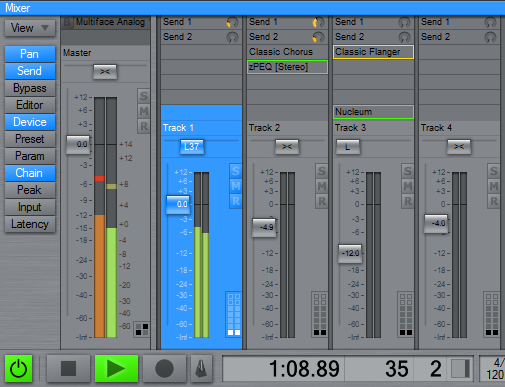
New since the latest beta2 is an option to show pan faders instead of dials, and an option to remove the hierarchy/signal flow arrows. Once you’re familiar with the Podium bottom up signal flow, you can remove the arrows to gain some valuable screen space.
Comments/suggestions will be appreciated.
ZynewaveKeymasterBeta2 is uploaded. I still need to implement some things and do major testing, so you will most likely notice bugs in this beta. To those that do try it, I will appreciate your comments on the changes to the mixer UI.
While working on the fader/meter features, one thing lead to another, and I ended up doing major revisions to the mixer UI. Some of the features in the mixer dates back to before the compact mode was implemented, so I’ve cleaned out some features and added some new ones that I’ve been thinking about for a long time:
• Changed the design of the mixer headers. The track name is now written at the top of the strip and not on the header.
• Added “small font” and “show send mapping and dial on same line” options to the mixer region properties.
• Added “Bypass” and “Editor” options to the column of mixer control buttons. Deselecting either of these will hide the buttons from the track headers and instead indicate bypass and editor state with a colored frame drawn around the device controls.
• Added mouse action settings to the mixer region properties dialog. Actions can be specified for click, shift+click, ctrl+click, alt+click, middle-click, right-click and double-click.
• Removed the “Compact headers” mixer view option, as it has become redundant with the new mixer options.
• Updated the mixer popup-help texts.
ZynewaveKeymasterA bookmark feature for often used folders is on my plan. Currently though this is a long way down the todo list.
ZynewaveKeymaster@Conquistador wrote:
I think I do understand but do not want to lose control of individual track faders in a chain as was possible before the current mixer Grid. For me that is all I am trying to maintain control of.
Currently we appear to have lost control of individual tracks faders. One move of the fader now and all tracks faders move accordingly. Fine if you only want to control one fader for any number of tracks in a chain.
Ah, it appears it is me that have misunderstood you all. You are talking about the fader behaviour if you show mixer strips for more than one track in a chain. That behaviour will be fixed, so that each fader will independently control the first gain/pan enabled track contained within the subchain. The current behaviour is buggy.
July 28, 2008 at 12:40 in reply to: Problems with playback of sysex dump from external hardware #12923ZynewaveKeymaster@Malcolm Jacobson wrote:
Switching to the Event List crashes Podium.
I am able to successfully capture and transmit the Weiss sysex dumps using MIDI-OX. I can send you a copy of one of those files if it would help solve the bug.
Yes, please send the file.
When you recorded the SysEx in Podium, did it result in only one SysEx event or a set of consecutive SysEx events?
ZynewaveKeymaster@Conquistador wrote:
It does seem a bit odd though to have a response setting for RMS meters and no such setting for Peak meters. Why not have both please? They are both equally useful.
They are not related. The “RMS window” is the time period over which the RMS values are calculated. Longer periods will result in a slower responding RMS meter with less peaks. By definition a “peak meter” shows the true meter value.
I like the idea of clicking on the meter to bring up the RMS meters. But…the documentation will have to be updated and / or some sort of pop up could appear the first time a user hovers over the meters to let them know about it. The pop up could automatically be disabled after that. Otherwise a very slick feature could be somewhat hidden.
When you move the mouse over the meter the meter background is highlighted. As in the rest of the Podium UI, this indicates that the meter can be clicked.
• Setting up pre/post faders and meters is now easily done with new shortcuts. The track menu has two new submenus: “Meter” and “Fader”. These menus shows all effect tracks in the chain, allowing to set the fader or meter at any effect in the chain. The submenus also has commands for enabling gain, pan, peak meter and RMS meter for each track.
I think the other guys noticed this as well…the faders are all linked. I am really not sure why. Very strange. Linking the faders or grouping them is actually a potentially very useful feature but…I don’t think that was what you had in mind…not just yet anyway.
I cannot see any reason why the faders must be linked the way they are now. Strange.
I’m puzzled why you all misunderstand this. Perhaps I haven’t described it properly in the above quote. Clicking the fader miniature MOVES the gain/pan controls to a different position in the chain. It does not select between separate settings on each effect track. Moving the controls works for setting up pre/post fader effects and bus sends, which is how other hosts/hardware mixers implement pre/post faders. You can see how this function if you look at the group panel in the track inspector when you click the miniature fader. If you had separate gain/pan controls on each effect track, you would have a huge number of controls that were not visible in the mixer. It would be a total nightmare to try to manage that during mixing.
Possible optional mixer strip behaviour…
I would like if possible to simply click on a compacted track header and have it replace the current track strip that is visible.
So instead of this…
^EQ
^ZComp
^Filter
^Instrument (this track is visible in the mixer)You would click on the Filter compacted track header and see this…
^EQ
^ZComp
^Filter (this track is now visible in the mixer identified by the name of the track as well)
^InstrumentOne could avoid having to unhide tracks just to to see their meters with this idea. Simlar to the grid idea but I think it extends it. Just a thought.
That is the purpose of the meter selector in the miniature. You click that to see the meter of the corresponding effect. This avoids having to show the strip for the effect track.